
Due to planned maintenance, your school has disabled school system log-ins at this time.
You may continue shopping as a guest, or by creating a bookstore-only account.
Please complete the purchase of any items in your cart before going to this third-party site.
Also note that if you qualify for financial aid, items purchased through this site will not be subject to
reimbursement.
Size: 8x0x10; J. Paul Getty Museum, Los Angeles, CA, Published date: 2001.
[...]
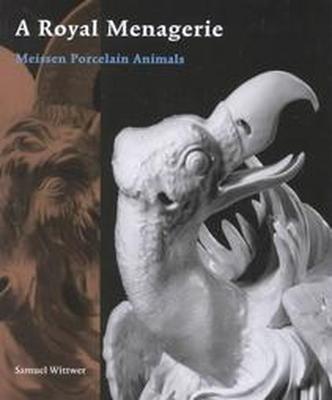
Size: 8x0x10; J. Paul Getty Museum, Los Angeles, CA, Published date: 2001. Softcover; 48 pp; 26 cm. Illustrated throughout with 30 color and 17 black-and-white illustrations; select bibliography. In very good condition. Glossy pictorial paper covers have light shelf wear and faint surface scuffing; Binding sound. Faint discolored patch on forward page from laid-in piece of paper; otherwise, interior pages clean and unmarked. Exhibition catalog published in conjunction with the 2001 Los Angeles exhibition devoted to the extraordinary large-scale Meissen porcelain animals commissioned by Augustus the Strong (1670-1733), Elector of Saxony and King of Poland. The volume examines the ambitious project to create nearly life-size porcelain animal figures for the Japanese Palace in Dresden between 1730 and 1735. Essays discuss the historical context of Augustus's collecting, the furnishing of the Japanese Palace as a "porcelain palace, " the role of Johann Joachim Kaendler (1706-1775) and Gottlob Kirchner (1706-), and the technical procedures and production challenges involved in modeling and firing monumental porcelain sculpture. Illustrated with detailed photographs of surviving animals including goats, birds, parrots, monkeys, tigers, and other figures from the Dresden Porcelain Collection. [From front flap] The extraordinary Meissen animals made for Augustus the Strong, who ruled simultaneously as elector of Saxony and king of Poland, were perhaps the most significant commission for porcelain ever executed in Europe. The figures, which were nearly life-size, presented enormous difficulties in making and firing, and their mere completion was a tour de force. Augustus the Strong (1670-1733) had long been a collector of Japanese and Chinese porcelain, and it was to house his collection that the Japanese Palace in Dresden was purchased. In 1729 Augustus enlarged the building to nearly double its original size in order to create a "porcelain palace." One gallery was to be entirely devoted to Meissen porcelain figures, including the exceptional animal figures that are the subject of this book and the exhibition it accompanies. The author, Samuel Wittwer, is curator of the ceramics collections at the Prussian Palaces and Gardens Foundation (Stiftung Preussische Schlosser und Garten Berlin-Brandenburg) and the historical archives of the Royal Porcelain Manufactory, Berlin.
Size: 8x0x10; J. Paul Getty Museum, Los Angeles, CA, Published date: 2001.
[...]
Size: 8x0x10; J. Paul Getty Museum, Los Angeles, CA, Published date: 2001. Softcover; 48 pp; 26 cm. Illustrated throughout with 30 color and 17 black-and-white illustrations; select bibliography. In very good condition. Glossy pictorial paper covers have light shelf wear and faint surface scuffing; Binding sound. Faint discolored patch on forward page from laid-in piece of paper; otherwise, interior pages clean and unmarked. Exhibition catalog published in conjunction with the 2001 Los Angeles exhibition devoted to the extraordinary large-scale Meissen porcelain animals commissioned by Augustus the Strong (1670-1733), Elector of Saxony and King of Poland. The volume examines the ambitious project to create nearly life-size porcelain animal figures for the Japanese Palace in Dresden between 1730 and 1735. Essays discuss the historical context of Augustus's collecting, the furnishing of the Japanese Palace as a "porcelain palace, " the role of Johann Joachim Kaendler (1706-1775) and Gottlob Kirchner (1706-), and the technical procedures and production challenges involved in modeling and firing monumental porcelain sculpture. Illustrated with detailed photographs of surviving animals including goats, birds, parrots, monkeys, tigers, and other figures from the Dresden Porcelain Collection. [From front flap] The extraordinary Meissen animals made for Augustus the Strong, who ruled simultaneously as elector of Saxony and king of Poland, were perhaps the most significant commission for porcelain ever executed in Europe. The figures, which were nearly life-size, presented enormous difficulties in making and firing, and their mere completion was a tour de force. Augustus the Strong (1670-1733) had long been a collector of Japanese and Chinese porcelain, and it was to house his collection that the Japanese Palace in Dresden was purchased. In 1729 Augustus enlarged the building to nearly double its original size in order to create a "porcelain palace." One gallery was to be entirely devoted to Meissen porcelain figures, including the exceptional animal figures that are the subject of this book and the exhibition it accompanies. The author, Samuel Wittwer, is curator of the ceramics collections at the Prussian Palaces and Gardens Foundation (Stiftung Preussische Schlosser und Garten Berlin-Brandenburg) and the historical archives of the Royal Porcelain Manufactory, Berlin.